 专注发泡胶整体解决方案
Foam-in-place packaging is a protective packaging method that generates polyurethane foam right at the packing station. Two liquid components — commonly called the A material and the B material — are mixed by a dispensing system and expand into foam that conforms to the exact shape of the product. Within minutes, the foam cures into a lightweight but rigid cushion that locks the item in place and protects it through transit.
The key difference from pre-formed inserts, molded trays, or die-cut foam blocks is that foam-in-place requires no dedicated mold for each product. The foam itself becomes the mold. That is why manufacturers and distributors with a wide product mix increasingly choose this technology: they no longer need to stock dozens of different cushioning shapes for different SKUs.

Standard packaging materials protect regular shapes well, but they struggle with products that do not fit a box neatly. Pumps and valves, automotive parts, optical instruments, LED lighting, robots, and decorative artware all share the same problem: their protruding parts, sharp edges, and irregular geometries leave gaps that generic cushioning cannot fill.
Those gaps matter. During shipping, vibration and impact let the product shift inside the box, collide with the carton wall, or rub against adjacent items. Foam-in-place packaging eliminates this by filling every void. The foam wraps the product surface, distributes impact energy across a larger area, and prevents abrasion caused by relative movement. For fragile items, the result is a dramatic drop in in-transit damage and customer returns.
Depending on your volume and budget, you can adopt foam-in-place packaging in three ways:
1. Hand-inflated foam bags. A pre-made bag contains the two liquid components in separate chambers. The operator activates the bag, places it under or around the product, and the foam inflates to fill the space. This is the lowest-cost entry point, ideal for low-to-medium packing volume, field packing, or items that are packed infrequently. It requires no machine investment and almost no training.
2. Semi-automatic foam packaging machines. The machine supplies the two components through a dispensing gun, and the operator controls where and how much foam to dispense — typically onto a film, under the product, or into the carton. Semi-automatic systems offer the best flexibility for medium volume and large or varied products, because an experienced operator can adapt the foam placement to each item.
3. Fully automatic foam packaging machines. The entire cycle — film feeding, foam dispensing, forming, and product handling — runs under PLC control with minimal manual intervention. Fully automatic systems suit high-volume lines with standardized workflows, where consistent output and lower labor cost per package matter more than flexibility.
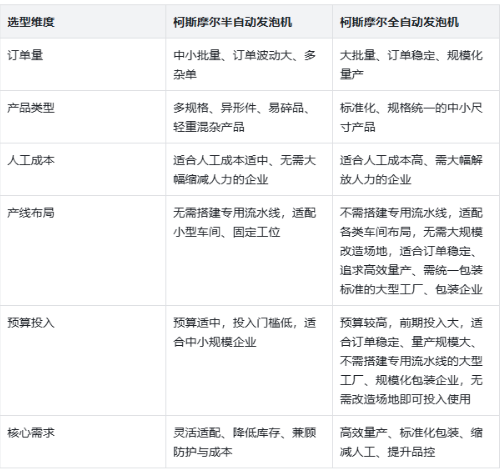
This is the question we hear most often from buyers, and the honest answer is that it depends on four factors:
How many packages do you produce per day? Generally speaking, semi-automatic machines handle most medium-volume operations comfortably. Once daily output grows to the point where operators become the bottleneck, a fully automatic machine starts to pay for itself through consistent cycle times and reduced labor.
How wide is your product mix? If you pack many different products in small batches, the flexibility of a semi-automatic machine is a real advantage. If you pack a few standardized products in high volume, a fully automatic line removes variation and improves repeatability.
How much labor can you commit? Semi-automatic systems need a trained operator at the station. Fully automatic systems shift the labor requirement to machine tending and line integration, which often fits factories that are already automating their packing processes.
What is your budget horizon? The initial investment in a fully automatic machine is higher, but the comparison should include material consumption, labor cost, and damage rates over the machine's service life. Many packers find that a fully automatic machine pays back faster than expected when throughput is high.

Foam-in-place packaging is widely used across industries. Common examples include water pumps and valves, where the foam protects threaded ports and flanges; automotive parts, where odd shapes and heavy weight combine; electrical and optical instruments, where precision surfaces must not shift; and artwork or crafts, where appearance matters as much as safety. Because the foam adapts to the product rather than the other way around, the application list is almost unlimited.
Foam-in-place packaging gives every product a custom-fit cushion without custom molds.
Hand-inflated foam bags are the simplest way to start; machines scale up your output.
Choose semi-automatic for flexibility and varied products; choose fully automatic for high volume and low labor cost per package.
Evaluate total cost — material, labor, storage, and damage rate — rather than machine price alone.
Foam-in-place packaging is one of the most practical ways to protect fragile and irregular products while keeping your packing process simple. Whether you start with hand-inflated foam bags or invest in a semi-automatic or fully automatic foam packaging machine, the technology adapts to your products instead of forcing your products to fit a standard cushion. Cosmolar — a source manufacturer of foam-in-place packaging — supplies the machines, the polyurethane foam AB material, and the consumables that make this process work, with technical guidance to help you select the right setup for your line.
Prices are for reference only; final quotes are provided by our sales team. For inquiries, please contact Cosmolar: Tel +86-400-812-0328 / +86-0755-27807490, website https://www.cosmolar.com/