 专注发泡胶整体解决方案
专注发泡胶整体解决方案
专注发泡胶整体解决方案
If you ship electronics, you already know the real cost is not the product itself — it is the damage. LED fixtures arriving with cracked housings, controllers that fail after a rough transit, servers knocked out of tolerance by vibration. Returns, repairs and lost customer trust add up fast, and moisture makes everything worse on long sea routes. Traditional cushioning often cannot keep up. This guide explains why foam-in-place packaging works so well for electronics, and how to apply it the right way.
Electronics fail differently from ceramics or glass. Many problems are invisible at first: loose connectors, cracked solder joints on circuit boards, corroded contacts, components shifted by constant vibration. The customer opens the carton, sees nothing wrong, plugs the device in — and only then discovers it is broken. By that point, responsibility is hard to prove.
That is why electronics packaging must do three jobs at once:
1. Absorb shock and vibration — spread impact energy across the whole surface;
2. Block moisture — keep humidity away from sensitive parts;
3. Lock the product in place — no shifting inside the carton.
Miss any one of these and damage rates stay high.
Foam-in-place packaging works by mixing two polyurethane components (A-side and B-side, also known as black and white chemicals) in the correct ratio. The mixture expands within seconds and forms a custom cushion that wraps tightly around the product outline.
For electronics, the practical benefits are clear:
1. Custom fit: the foam fills every gap and locks the product in place, so it barely moves in transit;
2. Shock absorption: the foam acts like thousands of tiny air pockets, spreading impact over the whole surface;
3. Moisture barrier: the foam layer separates the product from outside air, reducing humidity exposure;
4. Smaller cartons: less empty space means more products per carton and lower freight cost.
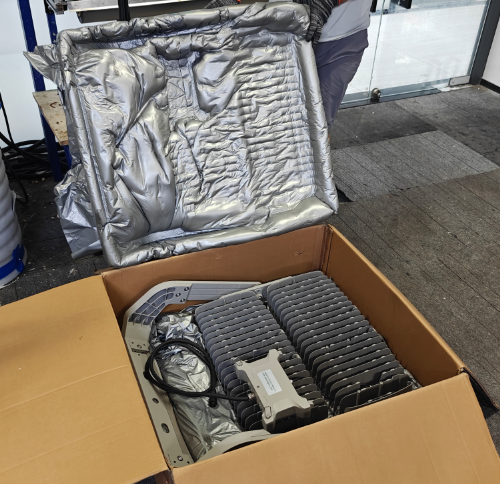
1) Expanding foam bags (hand-activated): zero investment, ready to use
No machine, no power supply. Press and knead the bag, the foam expands in 3-5 seconds, place the product and close the carton. Ideal for samples, urgent orders, low volume, or high-value single items such as servers and precision instruments.
2) Semi-automatic foam machine: balanced cost and output
Best for steady daily volumes of a few dozen to a few hundred packs. The operator lays film, dispenses foam, places the product and seals the carton. Foam density is consistent and the cost per pack is lower than hand bags. LED and electronics manufacturers use this option most.
3) Fully automatic foam-in-bag machine: production-line output
Bag forming, foam dispensing, cutting and sealing are fully automated. Suitable for high-volume, standardized products. Labor cost drops and quality control becomes more consistent.
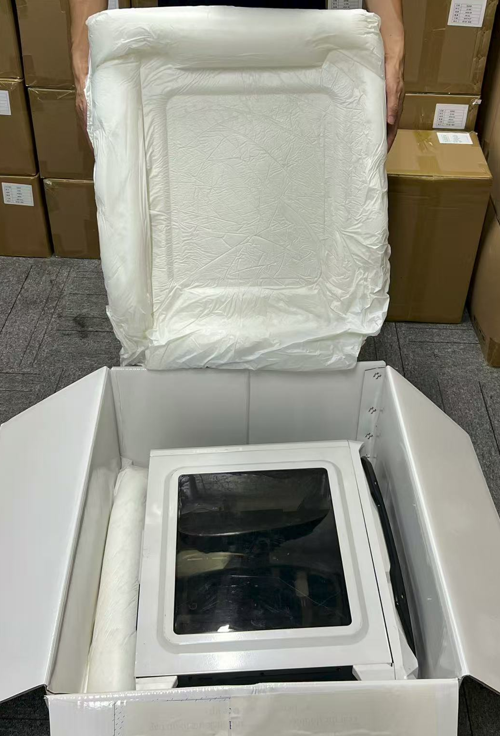
Using a semi-automatic foam machine as an example:
Step 1 — Lay the film: place foam packaging film at the bottom of the carton, leaving extra margin on each side so the foam does not stick to the product.
Step 2 — Dispense the foam: add the right amount for the product size and let it expand to a half-cured state.
Step 3 — Place the product: gently set the LED fixture into the foam and let it settle into its own outline, lens facing up.
Step 4 — Cover and seal: lay film and foam on top, close the carton and wait a few minutes for the foam to cure.
Once the operator is familiar with the routine, each pack takes one to two minutes. Most staff can learn the basics in half a day.
1. Electrostatic protection: place circuit boards and controllers in anti-static bags before the foam layer;
2. Desiccant for humid routes: for sea freight or rainy seasons, add desiccant inside the carton — the foam layer already blocks most humidity;
3. Film barrier: always separate the foam from the product surface with film to avoid residue;
4. Clear labeling: mark cartons as fragile and keep-dry to reduce rough handling.
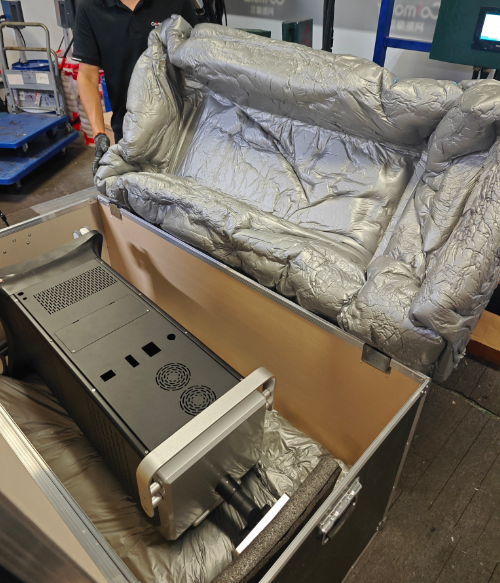
Q: Is foam-in-place safe for electronic components? Does it create static?A: The foam itself does not generate noticeable static. The safe practice is to put components in anti-static bags first, then pack with foam.
Q: We are a small LED manufacturer. Is it affordable?A: Start with hand-activated expanding foam bags — zero equipment investment. When volume grows, move to a semi-automatic machine and the cost per pack will drop clearly.
Q: Does it protect against humidity on sea routes?A: The foam layer separates the product from outside air and acts as a moisture barrier. Combined with desiccant, it works well for ocean freight.
Q: How much can damage rates drop?A: It depends on the shipping conditions and how well the pack is done. Once the product is locked in place, damage rates usually drop significantly in most scenarios. Test with your own product and run a drop test to get real numbers.
Electronics packaging comes down to three words: shock, moisture, stability. Foam-in-place packaging delivers all three in one step — no molds, no stockpiling mismatched foam boards. CosMolar, a source factory for foam-in-place packaging, supplies expanding foam bags, semi-automatic and fully automatic foam machines, A/B chemicals and film in one package, with free sampling so you can test with your own product before you commit.
Prices are for reference only; final quotes come from our sales team. Contact CosMolar: 400-812-0328 / 0755-27807490, official website https://www.cosmolar.com/