 专注发泡胶整体解决方案
Most ceramic sanitary ware damage comes down to one thing: the product is not locked in place. Toilets and basins are large, heavy and oddly shaped, so standard foam boards and cartons leave gaps — and every bump turns into a chipped rim. Foam-in-place packaging forms around the product and locks it inside the box. Cross-border logistics data shows damage rates can fall from around 10% to below 0.5% with layered protection. This article covers why sanitary ware breaks, how to choose a method, and how to pack it properly.
1. Large and irregular shapes: standard foam boards and cartons leave gaps, so the product moves inside the box and every knock chips the glaze;
2. High center of gravity: toilets and wall-hung basins sit high and tend to tip over and hit the side walls during transit;
3. Glaze is fragile: one knock means a chipped surface, high return rates and long disputes over who pays;
4. Many handling steps: factory, transit and last-mile delivery all add handling, and each step multiplies the chance of damage — even more so on ocean shipments.
| Method | Pros | Limits | Best for |
| PE foam sheets (EPE) | Cheap, easy to cut | Poor fit on irregular shapes; gaps remain | Standardized fixtures |
| Air column bags | Light, low cost | Limited cushioning; cannot stop large items moving | Small parts, gap filling |
| Foam-in-place (polyurethane foam) | Perfect fit, strong shock absorption, moisture barrier | Needs foam bags or a machine | Toilets, basins and other large ceramic pieces |
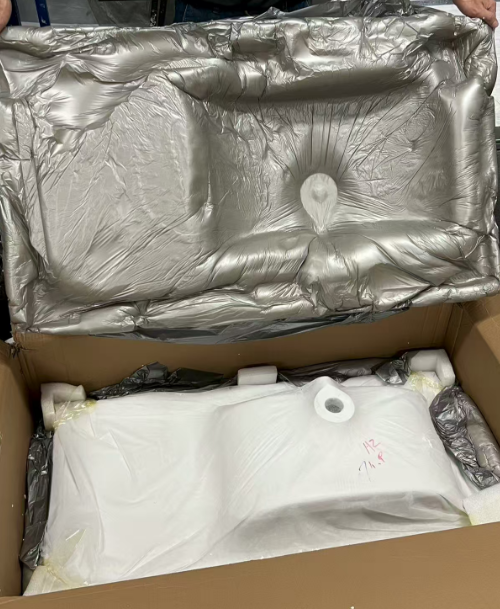
Step 1, build the base: lay film and dispense foam on the carton bottom; place the toilet or basin onto the half-cured foam so the base forms its own shape;
Step 2, fill the sides: dispense foam between the carton wall and the product so every gap is filled and the product barely moves;
Step 3, protect weak points: add extra foam around glazed edges, the drain outlet and fitting areas — these take the hardest knocks;
Step 4, cover and close: lay more film on top, dispense again, close the lid and press lightly, then wait for curing;
Step 5, label and reinforce: mark the carton "fragile" and "keep dry", add corner guards and a thicker base for heavy pieces to reduce rough handling.
1. Palletize and tie down: secure multiple cartons with stretch film and corner guards so nothing shifts and knocks during pallet transport;
2. Moisture control: sea containers are humid — add desiccant inside the carton, and the foam layer itself works as a moisture barrier;
3. Drop testing: before bulk shipment, run drop tests to GB/T 4857 or ISTA standards and let the data speak instead of relying on feel;
4. Replace the wooden frame where possible: with foam-in-place locking the product, some shipments no longer need a wooden frame, saving both the frame cost and the volumetric weight.
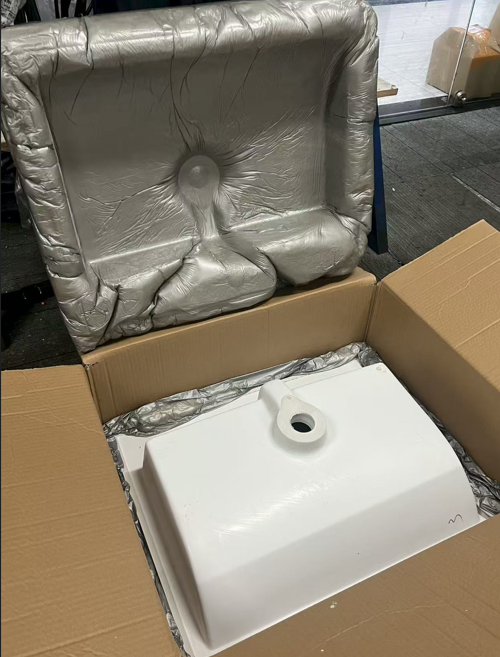

Cross-border logistics experience shows that with layered protection — air column bags, foam filling, reinforced cartons, corner guards, palletizing, shock pads and film wrap — ceramic sanitary ware damage can fall from around 10% to below 0.5%. Do the math: a premium toilet costs hundreds of dollars, and 1% damage means one claim per hundred units. The extra packaging cost is far lower than the losses from claims, returns and lost customers. And foam-in-place needs no molds and no stockpiles of mismatched foam sheets, so it stays flexible for small batches and mixed sizes.
Q: Can a toilet really be packed with foam-in-place?A: Yes — foam-in-place is the preferred method for large irregular ceramics. It forms around the product, touches every surface, and protects better than cutting foam sheets.
Q: What about a basin shipped separately from its countertop?A: Pack each piece separately in the same carton and separate them with a foam layer so they cannot knock against each other.
Q: What matters most for sea freight of sanitary ware?A: Moisture control (desiccant plus the foam layer), palletizing and tie-down, drop testing to GB/T 4857, and a thicker base for high-center-of-gravity items.
Q: Is foam-in-place worth it for small quantities?A: Start with hand-activated foam bags — zero equipment cost and the same custom fit; when volume grows, move to a semi-automatic machine for a lower cost per pack.
For large irregular ceramics like toilets and basins, packaging comes down to one word: fixation. Keep the product from moving inside the box and the damage rate drops. CosMolar, the source factory for foam-in-place packaging, supplies hand-activated foam bags, semi-automatic and fully automatic foam machines, A/B chemicals and film rolls as a one-stop solution, with free sampling — test-pack your own product before you decide.
Prices above are for reference only; the final quote comes from our sales team. For inquiries, contact CosMolar: 400-812-0328 / +86 755 2780 7490, official website https://www.cosmolar.com/