 专注发泡胶整体解决方案
Shipping irregularly shaped, fragile products is one of the most persistent headaches in B2B logistics. Auto parts with awkward contours, precision pumps and valves with delicate sealing surfaces, optical instruments with lens assemblies—conventional packaging (EPE foam, molded pulp, or custom die-cut polystyrene) rarely achieves a snug, gap-free fit. Every empty pocket inside the carton is a potential point of impact. Foam-in-place (FIP) packaging solves this by dispensing and expanding polyurethane foam directly around the product inside the shipping container, forming a custom cradle in seconds—no tooling, no molds, no pre-cut inserts.
Why Irregular Fragile Products Need Conforming Protection
Around 30–40% of all transport damage claims in industrial shipping involve parts with non-standard geometry. A die-cast aluminum pump housing with protruding ports, a machined valve body with threaded flanges, or a CNC-milled robotic component—these cannot be wrapped with flat EPE sheets or dropped into a standard foam cavity. Traditional cushioning requires either (a) ordering custom-molded EPS inserts (expensive, slow, MOQ-heavy, and dead weight after a single run) or (b) over-packing with loose fill (poor performance, bulky, unprofessional). Foam-in-place eliminates both problems by creating a 1:1 conforming cushion at the point of packing, on demand.

Real-World Applications Across Industries
Auto parts & powertrain components. Engine mounts, transmission housings, turbocharger parts, brake calipers, and machined suspension components are high-value and high-fragility. Foam-in-place locks the part in place regardless of its cast contours, so it cannot shift during LTL or container loading. CosMolar customers report transport damage rates dropping below 0.5% after switching from EPE wrap, and packing time falling from 5–8 minutes per box to under 2 minutes.
Pumps, valves & fluid control equipment. Cast-iron pump bodies, stainless steel valve assemblies, hydraulic manifolds, and solenoid blocks have machined sealing faces that cannot tolerate scuffing. A poured foam cradle grips the outside geometry while keeping pressure off critical flanges. The foam's inherent vibration damping also protects internal seals and diaphragms from resonance damage during transit.

Precision instruments, optics & electronic enclosures. Laboratory instruments, optical measuring devices, servo drives, PLC modules, and LED light assemblies require clean, dust-free, ESD-aware packing. CosMolar's foam system uses low-outgassing AB material that cures into a closed-cell, dust-free cushion. The 6 kg/m³ density variant delivers soft support for optics, while the 23 kg/m³ grade provides firm blocking for heavy machinery components.
How Tool-Free Custom Molding Works
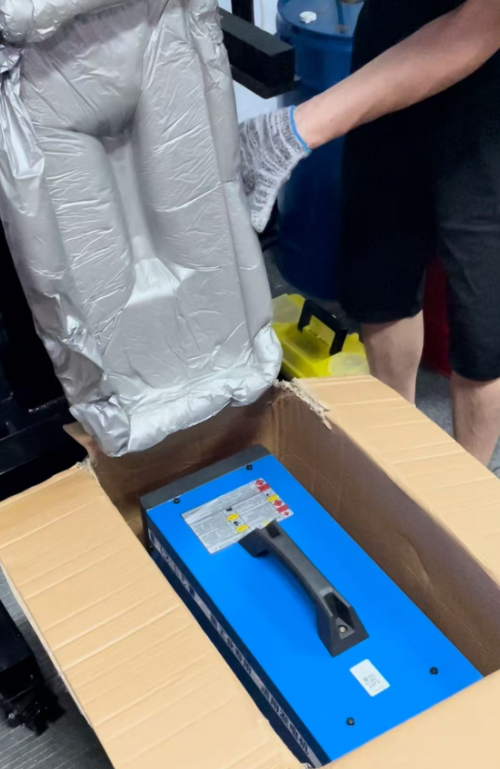
The process is straightforward. The operator places the product into a corrugated carton lined with PE film, then triggers the foam dispensing gun (on the CM-811 semi-automatic) or the robotic head (on the CM-812 fully automatic system). Two liquid components—black polyol and white isocyanate, known as AB material—mix through a static or mechanical stirrer and pour into a polyethylene film bag. Within 8–15 seconds the foam expands 20–30 times its liquid volume, hardens into a rigid-but-cushioning block, and conforms exactly to the product's shape. The result: a two-part custom cradle (bottom bed + top cap) that holds the part on arrival and peels away cleanly on the customer side. No mold design, no 2–4 week lead time, no minimum order quantity. A new product SKU can be packed the same day it arrives on the packing line.
360° Conforming Protection vs. EPE, Foam Peanuts & Molded EPS
Independent drop tests and field data from real industrial packing lines show that foam-in-place consistently outperforms EPE (pearl cotton) wrap on irregular shapes because EPE is flat sheet material—it can wrap around a cylinder but cannot fill under a flange or around a protruding sensor. Molded EPS fits perfectly but demands tooling investment of several thousand dollars and a minimum run of thousands of units. Foam peanuts, by contrast, offer poor cushioning for heavy parts and shift in the box. FIP bridges the gap: custom fit without the tooling burden, and at a total packaging cost that typically runs 30–50% lower than the molded-EPS route for mid-volume SKUs.
Designing Your Customized Foam Packaging Line
Every product has a different weight, geometry, fragility level, and drop-test requirement. CosMolar's engineering team works with buyers to specify the right foam density (6 / 17 / 23 kg/m³), the right carton size, and the right machine format. Low-volume / high-mix packers often start with the CM-811 semi-automatic unit, which frees the operator to position the product manually. High-volume, single-SKU lines benefit from the CM-812 fully automatic system, which dispenses foam in programmable cycles for consistent output. For buyers who want to test before committing, CosMolar offers free sample testing: send a product, receive a packed-and-drop-tested carton back.
The payback typically lands in 3–6 months once you factor in reduced damage claims, faster packing throughput, lower corrugated-box over-sizing, and elimination of custom tooling inventory. For irregular fragile products that currently sit in EPE-wrapped, bubble-bagged, peanuts-filled cartons, foam-in-place is the most concrete upgrade available.
Learn more about custom foam-in-place packaging solutions at https://www.cosmolar.com/