 专注发泡胶整体解决方案
专注发泡胶整体解决方案
专注发泡胶整体解决方案
When an overseas buyer sources polyurethane foam-in-place packaging equipment and material from China, the choice between a trading company, an integrator, and a true source manufacturer matters more than the headline unit price. CosMolar (Chinese: 柯斯摩尔) is a source factory headquartered in Shenzhen with its production base in Foshan—one of the Pearl River Delta's most established industrial clusters. This article covers the company's credentials, the latest CM-series machine upgrades, the service model, and what that means for B2B buyers evaluating a long-term packaging partner.
National High-Tech Enterprise: What the Certification Actually Means
In November 2023, the company was certified as a National High-Tech Enterprise (certificate number GR202344206404, valid for three years). This is not a generic award. The Chinese High-Tech Enterprise program requires demonstrated R&D investment, patent output, technical personnel ratio, and revenue from proprietary technology. For overseas buyers, the practical translation is simple: the supplier on the other end of the quotation is not a reseller—it has in-house engineering capability to tune foam formulations, iterate machine hardware, and co-develop custom packing lines with industrial customers. It also means the factory's cost structure is anchored in manufacturing rather than markup, which is why the CM-811 semi-automatic machines price around RMB 23,800, CM-816 units around RMB 21,800, and the CM-812 fully automatic system around RMB 63,000 (consumables extra) without a trading-company layer on top.

The Product Line: CM-Series Machines, AB Material, Hand-Squeeze Bags
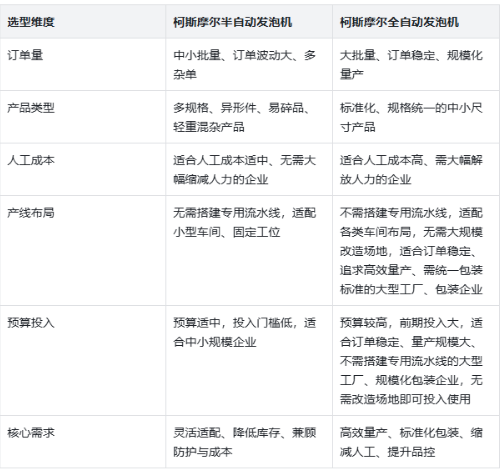
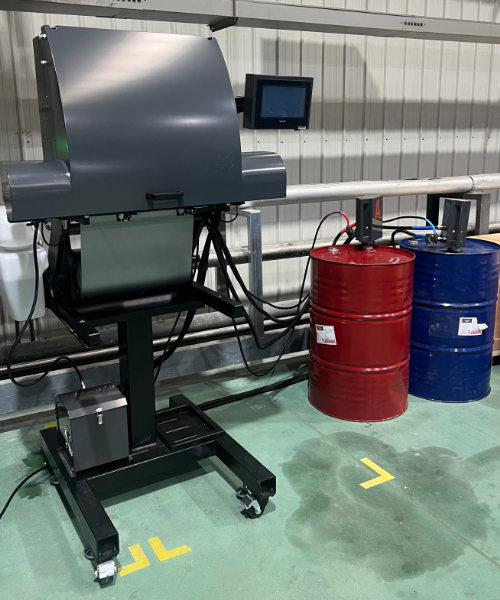
The product range is deliberately focused around the foam-in-place workflow. On the machine side, the CM-811 and CM-816 are semi-automatic dispensing units suited to high-mix packing lines; the CM-812 is the fully automatic system designed for high-volume, dedicated-SKU campaigns. On the consumable side, AB foam material (black polyol / white isocyanate) is produced in bulk drums at the Foshan base, available in 6, 17, and 23 kg/m³ density grades, paired with PE film bags that seal the expanding foam. For buyers not yet ready to commit to a machine, the hand-squeeze foam bags—18 sizes from X-60 to X-1800—offer a manual, equipment-free way to test foam-in-place protection on low-volume shipments. The insulation foam system serves the adjacent cold-chain and thermal-packaging niche.
What Changed in the 2026 CM-Series Upgrade
The current CM-series generation has been refined on three fronts that directly affect the buyer's day-to-day experience. First, the mixing head and stirrer blade have been redesigned for more consistent A/B ratio, reducing foam inconsistency and cut-down waste. Second, the HMI and recipe storage now handle more SKU profiles, so operators can switch between carton sizes with fewer manual tweaks. Third, the maintenance intervals on the high-wear parts have been extended, which lowers total cost of ownership over the machine's 7–10 year service life. On-time qualified delivery rate for production orders sits above 99%, which is a direct result of controlling both machine assembly and AB material production under one roof in Foshan.
Service Model: From Sample Test to On-Site Support
B2B packaging buyers rarely buy a machine without validating the protection on their own product. The standard entry point is a free sample test: the buyer sends a sample part, and the engineering team packs it in a foam-in-place carton, runs drop and vibration tests, and returns the result with a recommended density and machine configuration. Once an order is placed, every machine carries a 1-year warranty. Technical support runs on a 4-hour phone response SLA nationwide, with 24-hour on-site response inside the Pearl River Delta (Shenzhen, Guangzhou, Foshan, Dongguan and surrounding cities) and 48-hour response across the rest of China. For overseas buyers, remote video support, English-language documentation, and spare-parts shipping are built into the export package.
Cooperation Cases: Industries Already on the Platform
The customer base spans the irregular-fragile-product categories the technology is best suited for: auto parts suppliers shipping engine and transmission components, pump and valve manufacturers protecting machined sealing surfaces, motor and drive makers cushioning stator assemblies, precision-instrument OEMs packing optical and electronic measuring devices, and machinery builders crating CNC components and robotic parts. A smaller but growing segment is the crafts and cultural-products industry, where hand-painted ceramics and museum-grade reproductions move to foam-in-place from hand-carved foam inserts. Across these accounts, the consistent outcomes are a transport damage rate below 0.5%, a 30–50% reduction in total packaging cost versus traditional EPE or molded EPS, and packing time dropping from 3–10 minutes per box (traditional wrapping) to 1–2 minutes (foam-in-place).
Why Source Directly from the Factory
Buying foam-in-place packaging from a source manufacturer has three practical advantages. Price is the most obvious—no middleman margin, and material pricing is transparent in RMB or USD depending on the order. Technical depth is the second: formulation tweaks, custom density blends, and machine software adjustments are done by engineers who build the equipment, not by resellers relaying emails. Continuity is the third: a factory that makes both the machine and the AB material will still be around in five years, supplying consumables and spare parts. The Shenzhen HQ and Foshan production base sit inside one of the world's densest manufacturing ecosystems, which keeps component lead times short and export logistics efficient.
For buyers evaluating a long-term foam-in-place partner, the next step is a free sample test. Send a product, get back a packed-and-tested carton, and compare the protection against your current method. Explore the full machine and material range at https://www.cosmolar.com/