 专注发泡胶整体解决方案
Power tools and hardware parts for export are a typical irregular-metal-part packaging case: drills, angle grinders, wrenches, metal frames and mounting brackets carry chucks, bits, handles, slots and mounting holes, with painted, black-oxide, plated or machined surfaces. Once these items slide or rotate in the carton, protruding metal points knock against one another and mark the finish, and long sea freight with humidity changes can bring rust spots. This article explains how foam-in-place locates tools and hardware, isolates protrusions and protects against scratches and corrosion.
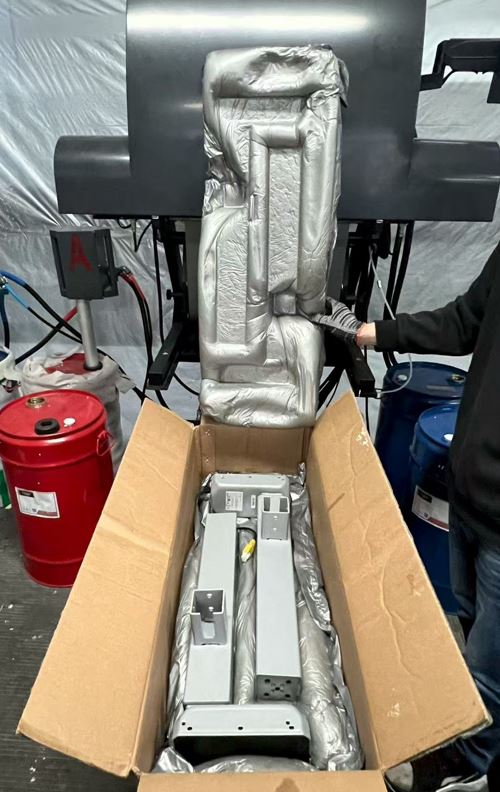
Where tool and hardware packaging goes wrong
First is protrusion-on-protrusion contact: chucks, bits, handles, gear wheels and mounting ears cluster around the housing, and traditional piece-by-piece foam rarely follows these uneven outlines, leaving play between parts that strike under vibration. Second is surface scratching: once a paint coat, black-oxide finish or plated layer touches another metal edge, the mark is hard to repair. Third is moisture corrosion: metal parts go through temperature and humidity swings inside a sea container, and surfaces that touch carton board or damp air directly are prone to rust spots.
How foam-in-place locates and isolates
CosMolar isolates first, then foams to the outline: the tool or hardware part is first wrapped in PE film or an isolation bag to keep moisture out and stop foam touching machined faces directly. A cushion layer is laid at the carton bottom, the product is placed in, extra foam fills around the housing outline, chuck and protruding points, then it is lightly pressed for 3-5 seconds to set. Once cured, the foam wraps the outline and stops the part rotating in the box. When several parts share one carton, foam layers or dividers separate them so metal never touches metal, and top-and-bottom cushioning absorbs vertical transit impact. No tooling is required for the insert, so a model change does not mean a new die.
Real results for export shipments
After switching to foam-in-place, tool and hardware customers see far less protrusion contact, surface scratching and moisture rust, with damage generally below 0.5% and an arrival pass rate above 99%; single packing takes about 1-2 minutes, against 3-10 minutes for piece-by-piece foam insertion and strapping. The fixing method can be validated first by sending a tool or hardware part for free trial packing, checking outline fit and removal before finalizing the insert.
CosMolar is a foam-in-place packaging source manufacturer focused on irregular, fragile products, serving power tools and hardware, automotive parts, pump and valve fluids, motor drives, precision instruments and machinery. More cases at https://www.cosmolar.com/.