 专注发泡胶整体解决方案
When LED luminaires, lighting modules and boards are exported, the assembly usually combines a board or bead array, a clear lens, a driver box and wiring harness. Beads are dense and shock-sensitive, the transparent lens marks easily, while the driver box and cables are protruding and prone to movement. Piece foam rarely fixes the lens, board and harness separately at the same time, so under vibration they still rub and pull. This article explains how foam-in-place protects lighting products to the outline.
Where lighting packaging goes wrong
Beads and the lens are the weakest parts: impact or pressure on beads causes dead beads or loose solder joints, and a lens rubbed by another edge or cable leaves scratches that hurt light output and appearance. Next, the protruding driver box shifts in the carton and presses against the board; loose harness tangles and pulls, possibly detaching connectors. Metal or plastic housings also need moisture isolation through sea freight temperature and humidity swings to avoid lens fogging or damp connectors.
How foam fixes layers in place
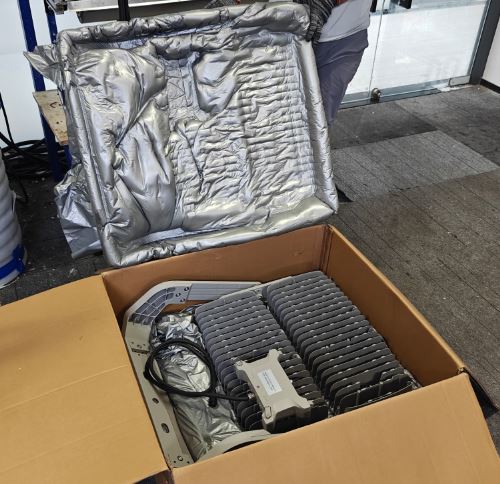
CosMolar isolates first, then foams to the outline: the lens and board are first wrapped in PE film or an isolation bag so foam does not touch the light-transmitting face or solder points directly. A cushion layer goes at the carton bottom, the product is placed in, extra foam fills around the board outline, driver box and cable positions, then it is lightly pressed for 3-5 seconds to set. Once cured, the insert locates the board and driver in the box and tucks the harness into reserved space so it no longer moves. The insert forms to the outline without tooling, so a luminaire model change does not mean a new die, and top-and-bottom cushioning absorbs vertical transit impact.
Real results for export shipments
After switching to foam-in-place, lighting customers see far fewer bead impacts, lens scratches and cable pull, with damage generally below 0.5% and an arrival pass rate above 99%; single packing takes about 1-2 minutes, against 3-10 minutes for piece-by-piece foam insertion and strapping harnesses. For very large lenses or dense bead arrays, free trial packing is recommended first to check outline fit and removal before finalizing the insert.
CosMolar is a foam-in-place packaging source manufacturer focused on irregular, fragile products, serving LED luminaires and lighting modules, automotive parts, pump and valve fluids, motor drives, precision instruments and machinery. More cases at https://www.cosmolar.com/.